How to Choose a Framing Contractor
What to look for in a GTA framing contractor: licensing, WSIB, insurance, questions to ask, red flags to avoid, and how to compare quotes accurately.
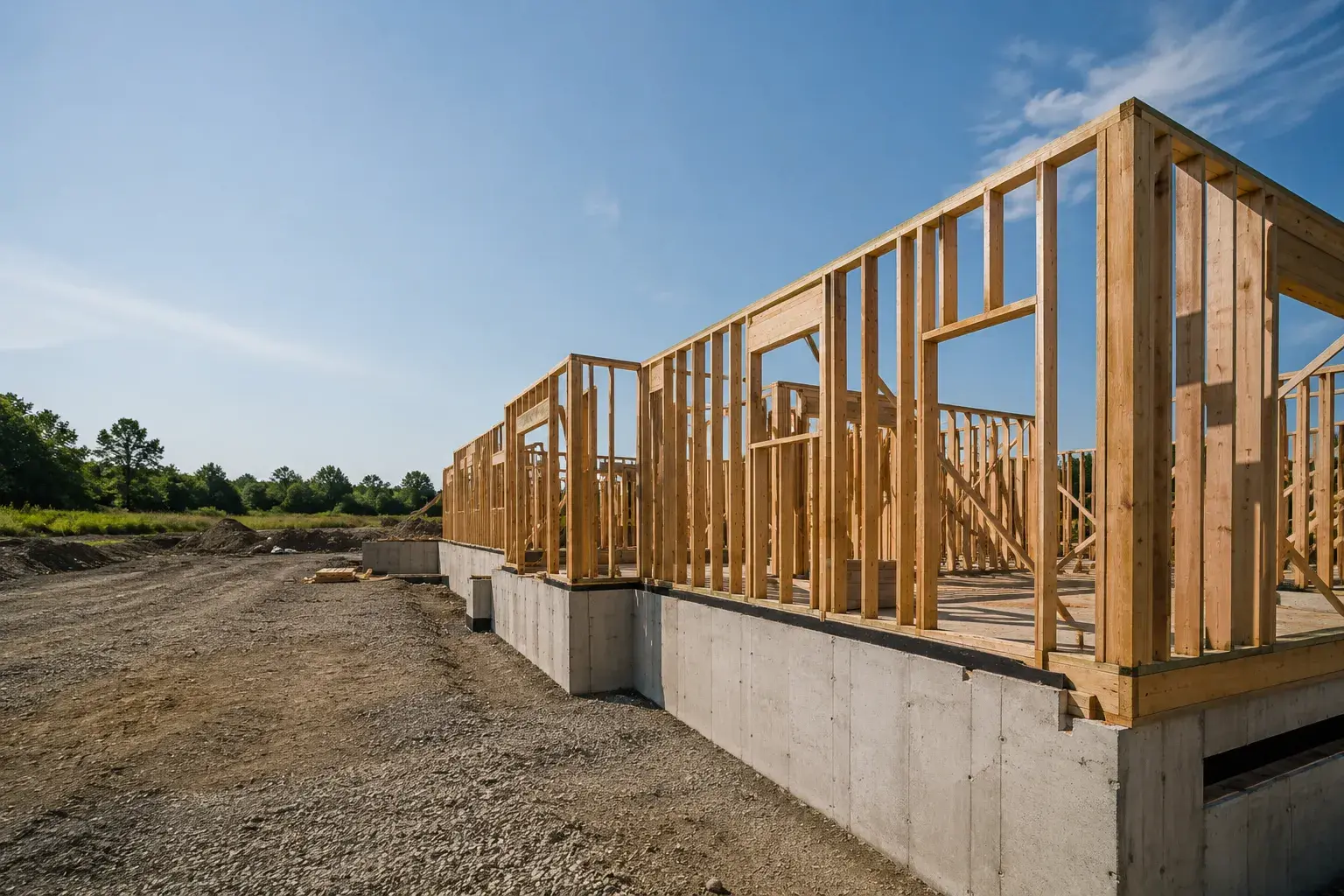
Framing is the structural skeleton of your building. Every other system, mechanical, electrical, insulation, cladding, drywall, attaches to it, runs through it, or depends on its geometry being correct. A framing error caught on day two is a minor correction; the same error found at drywall stage is a significant rebuild. Choosing the right framing contractor is one of the highest-leverage decisions you make in a build or renovation.
This guide covers the qualifications to verify, the questions worth asking before you sign, and the red flags that should end the conversation.
The Non-Negotiable Qualifications
Before any other evaluation, these three items must be confirmed. They are not negotiable, and no amount of low pricing or a nice website changes the calculus.
1. WSIB Registration
In Ontario, contractors who employ workers are required to register with the Workplace Safety and Insurance Board (WSIB). As an owner or general contractor engaging a framing sub-trade, you need to verify that the framing contractor has current WSIB coverage.
Why does this matter to you? If a framing worker is injured on your site and the contractor does not have WSIB coverage, you, as the person who engaged them, can be held liable under the Workplace Safety and Insurance Act. This is not a hypothetical. It happens.
How to verify: request a WSIB clearance certificate directly from the contractor. The certificate can be verified at the WSIB website using the contractor’s account number. It should be dated within 90 days of your request.
2. Liability Insurance
A professional framing contractor should carry a minimum of $2M general liability insurance. On larger custom-home projects, $5M is the standard for projects of meaningful scope. Ask for a Certificate of Insurance naming your project address as the insured location and confirming the coverage amount and policy expiry date.
Liability insurance protects you if the contractor’s work or operations damage your property or an adjacent property. Without it, a dropped beam through a neighbour’s fence, or worse, comes out of your pocket or triggers a legal dispute that the contractor cannot afford to resolve.
3. Ontario Business Licensing
While Ontario does not currently have a mandatory provincial trades licence specifically for framing (framing is not a designated trade under the Ontario College of Trades the way electrical and plumbing are), contractors should be properly registered as a business in Ontario and should be operating legally under HST registration if billing above the HST threshold.
Be wary of cash-only quotes or quotes explicitly excluding HST on commercial-scale projects. These are tax compliance signals worth taking seriously.
Questions to Ask Before Signing
”Can you provide references from similar projects?”
Not just any references, references from projects of comparable type and scope. A contractor who has framed a hundred residential additions may or may not be the right choice for a complex estate build with engineered timber and multi-storey open-concept spans. Ask for contacts who will actually speak with you, and call them.
Questions for references: Did they start and finish on schedule? Did the framing inspection pass first time? Were there any structural corrections required? Would you hire them again?
”What is your crew size and composition?”
A concrete answer here, “we’ll have a crew of four framers plus a lead”, is more credible than “we’ll staff to the project’s needs.” Know who is doing the work. Subcontracting to a secondary crew without disclosure is a common quality-control failure on GTA framing projects.
”Who is responsible for the permit and inspection?”
On some projects, the general contractor (or owner) holds the permit and is responsible for booking inspections. On others, the framing contractor takes this on. Clarify before starting. Ambiguity here leads to missed inspections and schedule disputes. See the full process explained in The Framing Permit & Inspection Process in Ontario.
”How do you handle structural engineering requirements?”
For any project with non-prescriptive elements, long spans, structural beam installation, post-and-beam framing, load-bearing wall removal, stamped engineering drawings are required. The contractor should be experienced in working from engineer’s drawings and should know immediately whether a given design element falls under OBC prescriptive provisions or requires engineering. Confusion on this point is a credential gap.
”What is your experience with [specific project type]?”
Custom home framing and home addition framing have different demands. Renovation framing in existing structures requires skills that new construction does not, working around existing out-of-plumb conditions, integrating new framing with legacy systems, structural repair framing on rotted or damaged members. Commercial framing and mezzanine framing fall under different OBC provisions than residential. Ask specifically.
”What does your quote include?”
A detailed scope review before signing is not optional. Understand exactly what is in scope: wall framing, floor and joist systems, roof and truss framing, subfloor and sheathing, stair framing, window and door opening framing, soffit and bulkhead framing. And what is explicitly excluded: permits, engineering, crane, scaffolding, waste removal, truss supply. A quote without a scope narrative is not a quote, it is a number.
For a full breakdown of what should be in a framing quote, see How Much Does Framing Cost in the GTA?
”What is your payment structure?”
Progress payments tied to milestones (floor complete, walls up, roof framed, inspection passed) are standard and reasonable. A contractor demanding a large upfront deposit, more than 10-15% on residential work, before mobilizing is a yellow flag. A contractor demanding the majority of payment before the framing inspection is passed is a red flag.
Red Flags
These are not minor concerns. Each one should materially increase your caution or end the conversation entirely.
No WSIB clearance certificate. Not “I’ll get you one” or “we’re in the process of renewing.” A valid, verifiable certificate. If it cannot be produced, stop.
No proof of insurance. Same standard. A professional contractor has it immediately available.
Cash-only pricing on mid-to-large projects. This implies tax non-compliance and typically correlates with no formal legal entity, meaning there is nothing to sue if something goes wrong.
Unlicensed or unregistered subcontractors. Ask directly if the crew doing the work will be the contractor’s own employees or subcontractors. If subcontractors, who are they, and do they carry their own WSIB and insurance? Contractors who cannot answer this clearly are often running a brokering operation with no actual quality control.
Inability to explain OBC requirements. An experienced framing contractor should be able to speak fluently about building code requirements for the project type you’re discussing, span limits, fire blocking, header sizing, structural connector requirements. Vague answers or deflection to “the inspector will tell us what’s needed” are indicators of a crew that operates reactively rather than to standard.
A schedule commitment with no basis. “We’ll have it done in four weeks” means nothing without a crew-size commitment, a material delivery plan, and an acknowledgment of what’s needed from you to hit the date. See How Long Does It Take to Frame a House? for realistic timeline expectations.
Pressure to proceed immediately without a signed contract. No legitimate contractor should be pushing you to commit without written scope, payment terms, and schedule. Urgency tactics in residential construction are almost always designed to bypass the due diligence that would reveal problems.
No Google or HomeStars presence, or a thin review history. This is not disqualifying on its own, newer companies can be excellent, but a contractor doing quality residential work in a market as large as the GTA should have some verifiable track record. Absence of reviews combined with other yellow flags is worth noting.
How to Compare Multiple Quotes
Getting three quotes is standard practice. Comparing them meaningfully requires that the scope be identical across all three.
- Standardize the scope, send each contractor the same drawings and the same written scope description. Ask each to price the identical work.
- Ask each contractor to itemize, labour, material allowance, specific inclusions and exclusions
- Compare total cost of ownership, not just price, a quote that includes sheathing and subfloor at $X is not directly comparable to a lower quote that excludes them
- Weight the qualifications, the lowest quote from an unregistered crew is more expensive than the highest quote from a fully qualified contractor if anything goes wrong
What Good Looks Like
A contractor worth engaging will:
- Produce WSIB clearance and insurance certificates without hesitation
- Ask to review your drawings before quoting (and flag concerns)
- Provide a detailed written scope with itemized inclusions and exclusions
- Commit to a specific crew size and start date
- Have verifiable references from comparable projects
- Pass framing inspections on the first visit as a matter of course
Timberr Framing is WSIB covered, carries $5M liability insurance, and holds a 5.0 rating across 40+ Google reviews and 11 HomeStars reviews, serving the GTA, York Region, and SW Ontario. Request a quote or contact us to discuss your project.